

Multi-image capture per stop
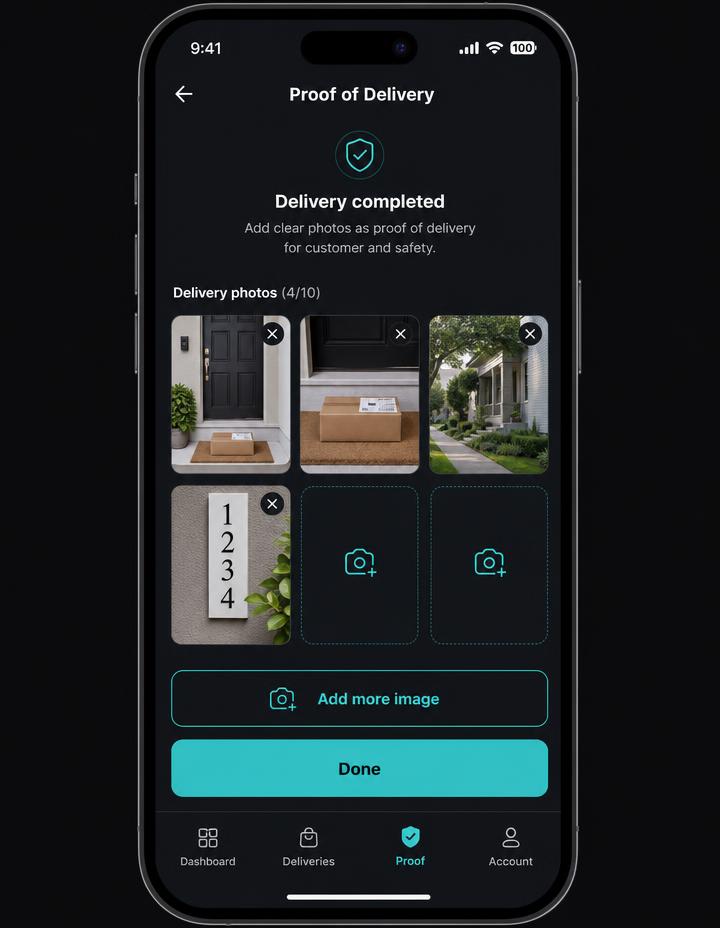
Unlimited photos across goods and document batches, stacked into one consolidated record and locked with a single action.
Photo, signature, GPS and timestamp captured on the phone the driver already owns — offline if needed — and emailed to the customer before the tailgate is shut.
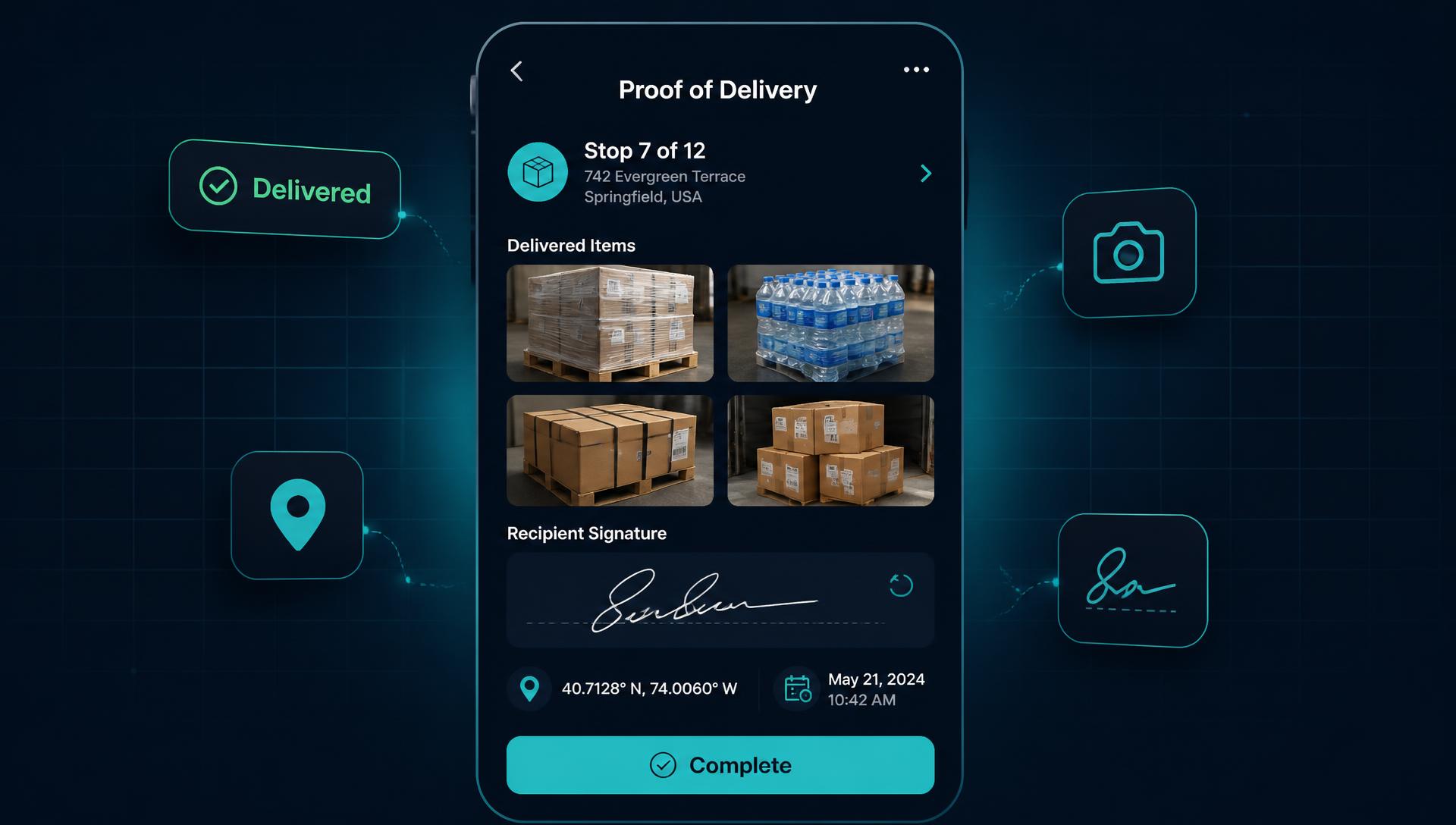
Everything a claims handler, an auditor or a customer-service agent needs, captured without extra driver effort.
Unlimited photos across goods and document batches, stacked into one consolidated record and locked with a single action.
On-screen signature capture plus recipient name, or a contactless photo-and-name record where signatures are not collected.
Arrival, capture and completion are stamped with time and position, so disputed deliveries are settled with data rather than recollection.
Stops close without signal. Media and statuses queue on the device and sync the moment the connection returns.
Proof-of-delivery emails leave instantly with every attachment and your own reference convention in the subject line.
Refusals, damage and no-access are logged against a fixed reason-code list, giving you a clean failed-delivery dataset to act on.
Workspace-isolated data, hash-chained shift logs and 15-minute signed media links keep evidence defensible and private.
Dispatchers see each ePOD land in mission control as it happens, so customer service answers before the customer calls.
The driver opens the next stop and taps Arrived. The status, time and position reach dispatch instantly.
Photograph the goods, then the signed paperwork, and add a signature or recipient name. Lock the batch when the stop is done.
The ePOD record is sealed and emailed to the chosen recipients with all media attached, then archived in the workspace.
The paper delivery note costs money three times: at the door, in the office and in the claim.
A timestamped photo set with GPS and a named recipient settles damage and non-delivery claims without a week of email.
Billing no longer waits for scanned slips: the proof lands in the back office the second the stop closes.
Structured reason codes turn failed deliveries into a fixable pattern instead of a driver anecdote.
Proof of delivery is one part of a wider move to digital transport documents.
An ePOD proves the handover. An eCMR is the consignment note itself — the contract of carriage for cross-border road freight. Most fleets run ePOD first because it needs no counterparty agreement, then adopt eCMR lane by lane.
Advance notification, exact-door navigation and structured reason codes cut the first-time-failure rate; the ePOD record then proves which attempts were made and when.
ePOD stands for electronic proof of delivery: a digital record that a consignment was handed over, replacing the paper delivery note. A Depot2Door ePOD bundles the delivery status, timestamp, GPS position of the stop, photos of the goods and paperwork, the recipient's name and a captured signature into one immutable record.
Yes. Electronic records are admissible as evidence across the EU under Regulation (EU) 910/2014 (eIDAS), which states that an electronic document may not be denied legal effect solely because it is electronic. For international road freight, the eCMR protocol (Additional Protocol to the CMR Convention, in force since 2011) gives digital consignment notes the same standing as paper ones in ratifying countries. Depot2Door stores each ePOD with a tamper-evident hash chain and time-limited signed links so you can produce it in a claim.
Yes. The driver app is offline-first. Route, stop and customer data live on the device, and completed stops, photos and signatures queue locally, then upload automatically when coverage returns. Nothing is lost in a basement car park, a service lift or a border dead zone.
Automatically, the moment the stop is closed. The ePOD email carries every captured image and the stop's reference in your own subject convention (route_stop), and can route to the office, the client contact, or both. No end-of-day scanning and no chasing drivers for slips.
Yes. Signature and document capture run inside the same batch flow as goods photos, so one lock action seals the whole set. For contactless or no-signature policies, a named-recipient plus photo record is equally valid as evidence.
Records stay in your workspace for as long as your retention policy requires — most European operators keep proof-of-delivery evidence for at least the one-year CMR claim period, and often seven years to match invoice retention. Media is served through short-lived signed links, never public URLs.
Yes. Every delivery record is available through the Depot2Door API and agent (MCP) integration layer, so ePOD status, timestamps and media references can be posted to your TMS, ERP or invoicing system as soon as a stop closes.
Want the full driver-side picture? See the driver shift & mobile app, or the dispatcher TMS.
Cloud-based transport management system with dispatcher mission control.
Offline-first courier mobile software with multi-image proof of delivery.
Automated EU 561/2006 driving-time tracking, split-break logic and a dual-driver HUD.
EU cross-border transport software with geofencing and driving-hours checks.
Sandbox planning, 2-opt optimisation and one-click publishing to the fleet.
Per-vehicle pricing with modular add-ons — no per-seat surprises.