

EU driving hours compliance
A 4.5-hour driving countdown with a proactive five-minute warning, an automatic break prompt and a logged reset that keeps the record clean.
Multi-page manifest parsing, digital waybills, geofenced border alerts and EU driving hours compliance — one audit trail from depot to door across every member state you run.
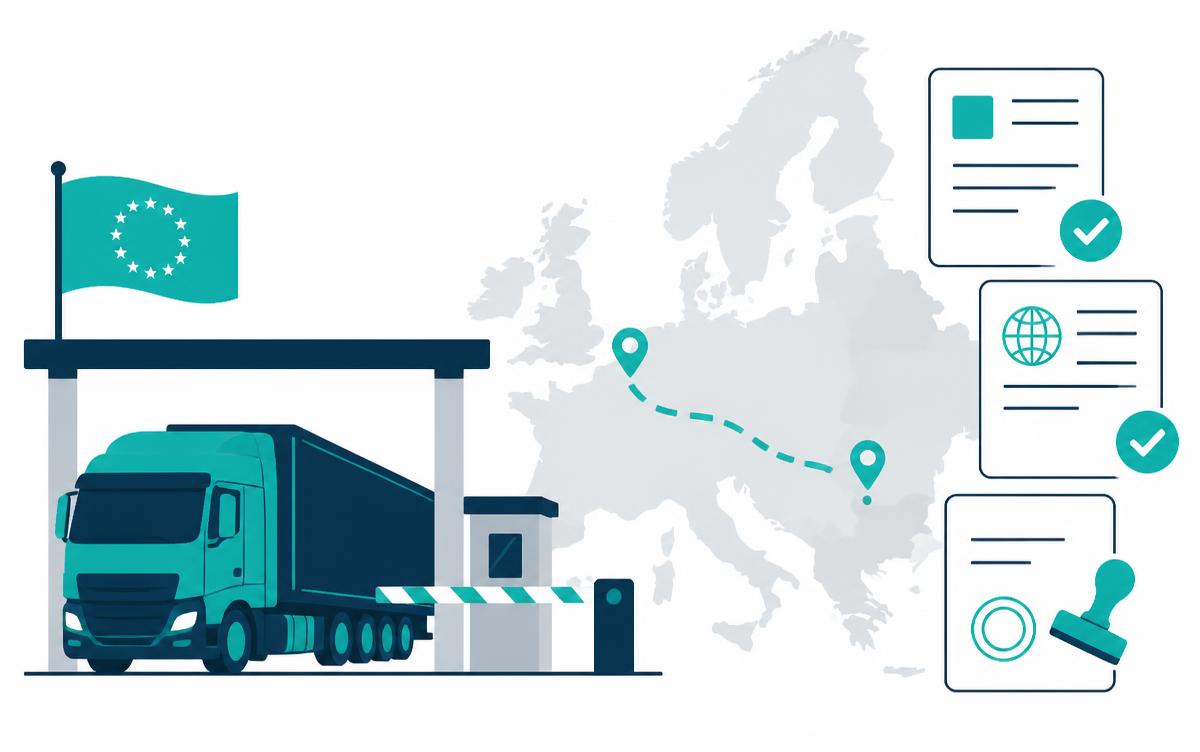
The rules are enforced where the work happens — in the plan and in the cab.
A 4.5-hour driving countdown with a proactive five-minute warning, an automatic break prompt and a logged reset that keeps the record clean.
Route plans are checked against rest-time constraints before dispatch. Violations need an explicit override reason, captured in the audit log.
Ingest multi-page spreadsheets and PDF confirmations into one structured digital waybill per stop, with dry-run validation before anything goes live.
Customs points, low-emission zones and restricted urban areas as vehicle-class-aware overlays on the dispatcher map.
Routes crossing a flagged zone raise an alert to the planner and a notice in the driver app before the vehicle reaches the crossing.
Drivers from any EU corridor read their manifest, break prompts and customer messages in their own language, RTL included.
International manifests arrive in whatever shape the shipper uses. Depot2Door normalises them: saved column-mapping templates per customer, address expansion so shorthand street names resolve to the exact door, duplicate-import detection, and a validation report you can read before committing.
Booking confirmations are parsed into a hotel card with the reference, address and navigation link the driver needs at 22:00 in another country.
Camera-scanned odometer and fuel readings with photo evidence, filed against the route and visible to dispatch in real time.
Every break, override, status change and proof-of-delivery image is timestamped and exportable for claims or inspections.
A tachograph-style timer tracks the 4.5-hour driving limit in the driver app, flashes a warning five minutes before the limit, and prompts a logged break that resets the countdown. Dispatch-side, route schedules are validated against EU 561/2006 rest constraints before a plan can be pushed to a driver.
International runs arrive as multi-page spreadsheets and PDFs with inconsistent columns. The parser reads them, maps columns using saved templates, validates addresses and references, and produces a single digital waybill per stop that both dispatch and driver work from.
Geofenced zones — customs points, low-emission zones and restricted urban areas — sit as toggleable overlays on the dispatch map and raise alerts on routes that cross them, so planners catch a vehicle-class problem before the truck is at the barrier.
Yes. Pre-trip logs, break records, stop completions, photo evidence, dispatcher overrides and override reasons are all timestamped against the route and can be exported for a customer claim or an inspection.
Want the driver-side view? See the ePOD and driver shift app .
These capabilities are offered as part of a licensed Depot2Door deployment and switched on per tenant — talk to us about the ones your corridors need first.
A legally structured electronic CMR aligned with the EU eFTI Regulation (2020/1056), ready for the 2027 authority-acceptance deadline so freight data is machine-readable at the border.
Per-country cabotage rule tracking and posting-certificate generation so cross-border assignments stay legal without a spreadsheet per member state.
ISO 14083 / GLEC-aligned emissions accounting per load and corridor for tender responses and CSRD sustainability disclosure.
EX-1, T1 and T2 transit document capture and validation reconciled against the manifest stop record, not filed separately.
Cloud-based transport management system with dispatcher mission control.
Offline-first courier mobile software with multi-image proof of delivery.
Automated EU 561/2006 driving-time tracking, split-break logic and a dual-driver HUD.
EU cross-border transport software with geofencing and driving-hours checks.
Sandbox planning, 2-opt optimisation and one-click publishing to the fleet.
Per-vehicle pricing with modular add-ons — no per-seat surprises.